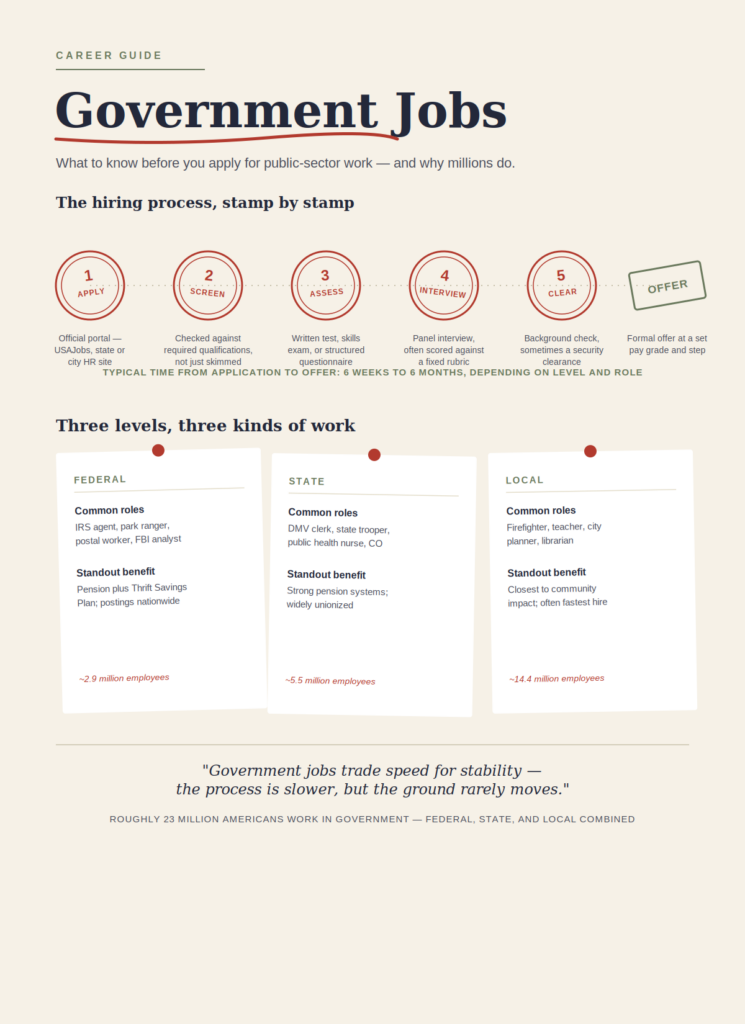
Government jobs are among the most sought-after employment opportunities in South Africa. Every year, thousands of people apply for positions in national, provincial, and local government departments because they offer stable employment, competitive salaries, and opportunities for career growth.
Whether you’re a recent graduate, an experienced professional, or someone looking for a career change, government employment can provide a rewarding and meaningful career.
However, applying for a government job is different from applying to a private company. There are specific application procedures, required documents, and eligibility criteria that every applicant should understand.
This guide explains how government jobs work, where to find vacancies, how to apply successfully, and common mistakes to avoid.
What Are Government Jobs?
Government jobs are positions within public sector organizations that provide services to citizens and support the functioning of the country.
These jobs exist across various levels of government, including:
- National government departments
- Provincial government departments
- Municipalities
- Public entities
- State-owned enterprises
- Constitutional institutions
Government employees work in many different professions, from administration and finance to healthcare, engineering, education, law enforcement, and information technology.
Why Many People Want Government Jobs
Government positions remain popular because they often provide benefits beyond a monthly salary.
Some of the advantages include:
Job Stability
Government departments generally offer more employment stability than many private-sector organizations.
Competitive Salaries
Many government positions provide structured salary scales that increase according to experience, qualifications, and job level.
Employee Benefits
Depending on the position, employees may receive benefits such as:
- Pension contributions
- Medical aid options
- Paid annual leave
- Sick leave
- Maternity and parental leave
- Housing allowances (for some positions)
- Training and development opportunities
Career Development
Government organizations often encourage employees to continue learning through:
- Skills development programmes
- Internal promotions
- Leadership development
- Professional training
Opportunity to Serve the Public
Many people choose government careers because they want to contribute to improving communities and delivering essential public services.
Types of Government Jobs
Government departments recruit professionals from almost every career field.
Examples include:
Administrative Positions
- Administrative Clerk
- Office Administrator
- Personal Assistant
- Receptionist
- Human Resources Administrator
Finance
- Accountant
- Financial Officer
- Internal Auditor
- Budget Analyst
- Supply Chain Officer
Information Technology
- IT Technician
- Systems Administrator
- Network Engineer
- Cybersecurity Specialist
- Software Developer
Healthcare
- Professional Nurse
- Medical Officer
- Pharmacist
- Physiotherapist
- Occupational Therapist
Education
- Teacher
- Lecturer
- Curriculum Specialist
- Education Administrator
Engineering
- Civil Engineer
- Mechanical Engineer
- Electrical Engineer
- Town Planner
Law Enforcement and Safety
- Police Officer
- Traffic Officer
- Correctional Services Officer
- Firefighter
Who Can Apply for Government Jobs?
Most government vacancies are open to South African citizens who meet the advertised requirements.
Requirements usually include:
- A valid South African ID
- Appropriate qualifications
- Relevant work experience (where required)
- Good communication skills
- Computer literacy (for many office positions)
- A clean criminal record for certain roles
Some positions may also require:
- A valid driver’s licence
- Professional registration
- Security clearance
- Medical examinations
- Competency assessments
Always read the job advertisement carefully before applying.
Where to Find Government Job Vacancies
Government vacancies are published through official channels.
Common sources include:
- National and provincial government career portals
- Individual government department websites
- Municipal websites
- Public entity career pages
- Official public service vacancy bulletins
- Reputable job websites
Be cautious of unofficial websites requesting payment to apply.
Legitimate government job applications do not require you to pay application fees.
Understanding Job Levels and Salary Grades
Many government jobs are advertised using salary levels or grades.
These levels determine:
- Salary range
- Responsibilities
- Required qualifications
- Experience expectations
Higher salary levels usually require greater experience and leadership responsibilities.
Understanding these levels helps you apply for positions that match your qualifications.
Documents You’ll Usually Need
Before applying, prepare electronic copies of:
- Updated CV
- Certified copy of your ID (if requested)
- Certified copies of qualifications
- Academic transcripts (where applicable)
- Driver’s licence (if required)
- Professional registration certificates
- Supporting documents requested in the advertisement
Keep all documents clear and easy to read.
How to Apply for a Government Job
Step 1: Read the Advertisement Carefully
Pay attention to:
- Closing date
- Minimum qualifications
- Required experience
- Application method
- Reference number
Never assume every vacancy follows the same process.
Step 2: Prepare Your CV
Your CV should be:
- Up to date
- Tailored to the position
- Free of spelling mistakes
- Easy to read
- Relevant to the advertised role
Highlight achievements rather than simply listing responsibilities.
Step 3: Complete the Required Application Form
Many government departments require applicants to complete an official application form in addition to submitting a CV.
Fill in every section carefully and honestly.
Incomplete applications may be disqualified.
Step 4: Submit Before the Closing Date
Late applications are generally not accepted.
Submit your application early whenever possible.
Step 5: Wait for Communication
If shortlisted, you may be invited for:
- Interviews
- Written assessments
- Practical tests
- Verification checks
Only shortlisted candidates are usually contacted.
Tips to Improve Your Chances
Competition for government jobs can be high.
To improve your chances:
- Tailor your CV to every vacancy.
- Include all requested documents.
- Follow application instructions carefully.
- Meet every minimum requirement before applying.
- Proofread your application.
- Keep copies of everything you submit.
- Apply consistently rather than waiting for one perfect opportunity.
Preparation and attention to detail can make a significant difference.
Common Mistakes to Avoid
Many applications are rejected because applicants:
- Forget to include required documents.
- Miss the closing date.
- Ignore application instructions.
- Submit incomplete forms.
- Use outdated CVs.
- Apply without meeting minimum qualifications.
- Provide inaccurate information.
Taking a few extra minutes to review your application can prevent these mistakes.
What Happens After You Apply?
After the closing date, departments generally follow a structured recruitment process:
- Applications are screened.
- Candidates who meet the requirements are shortlisted.
- Interviews and assessments are conducted.
- References and qualifications are verified.
- The successful candidate receives an offer.
This process can take several weeks or even months, depending on the department and the number of applications received.
Patience is important when applying for public sector positions.
Frequently Asked Questions
Do I need experience to get a government job?
Not always. Many internships, graduate programmes, learnerships, and entry-level positions are designed for candidates with little or no experience.
Can I apply for more than one government job?
Yes. You may apply for multiple vacancies as long as you meet the requirements for each position.
Are government jobs permanent?
Some positions are permanent, while others are contract-based or temporary. Always check the job advertisement for the employment type.
Do government jobs pay well?
Government salaries vary depending on the role, qualifications, experience, and salary level. Many positions also include additional employment benefits.
Can I apply online?
Many departments now accept online applications, while others may require email or manual submissions. Always follow the application instructions in the vacancy advertisement.
Final Thoughts
Government jobs offer more than just a salary—they provide opportunities to build a stable career while contributing to the development of South Africa and the delivery of essential public services.
Although the application process may seem detailed, understanding the requirements and following the instructions carefully can significantly improve your chances of success. Prepare a professional CV, gather the necessary documents, apply before the closing date, and ensure every application is tailored to the specific role.
With persistence, preparation, and a commitment to continuous learning, you can position yourself as a strong candidate for government employment. Every successful public servant started with a single application, and your next opportunity could be just around the corner.