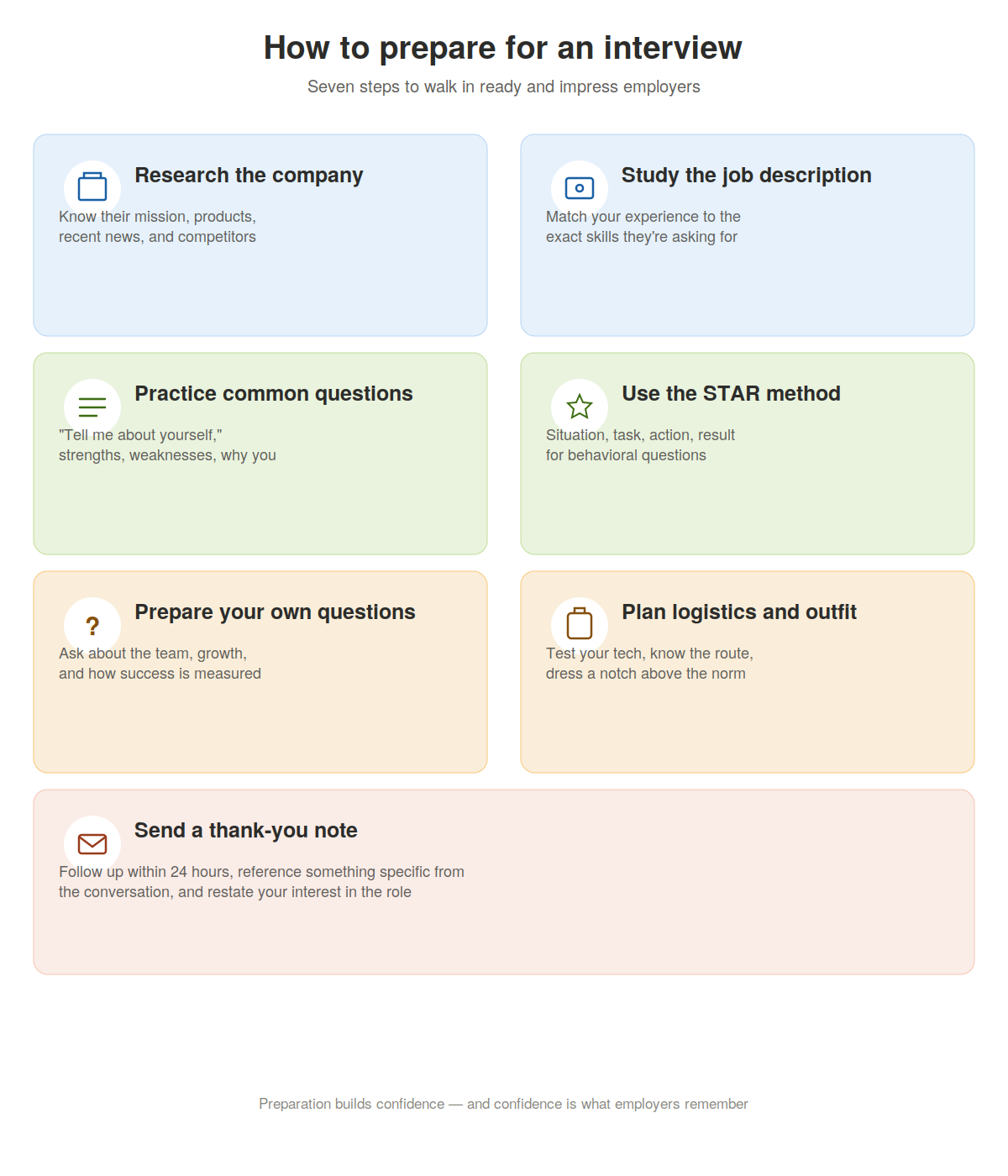
Getting invited to an interview means you’ve already achieved the first milestone—your CV has convinced the employer that you’re worth meeting. Now it’s your opportunity to prove that you’re the right person for the job. The good news is that interviews are a skill you can improve with preparation and practice.
Whether you’re applying for your first job, a graduate programme, an internship, or a senior position, proper preparation can significantly increase your chances of success.
Research the Company
One of the biggest mistakes candidates make is arriving at an interview without knowing anything about the employer.
Before your interview, research:
- The company’s history
- Their products or services
- Mission and values
- Industry they operate in
- Recent news or achievements
- Company culture
Visit the company’s official website and social media pages. Understanding the organisation shows genuine interest and helps you answer questions more confidently.
Understand the Job Description
Read the job advertisement several times.
Pay attention to:
- Required qualifications
- Responsibilities
- Skills required
- Experience needed
- Software or tools mentioned
Think about examples from your own experience that match each requirement.
If the interviewer asks why you’re suitable for the role, you’ll already have relevant examples prepared.
Review Your CV
Everything on your CV is fair game during an interview.
Be prepared to explain:
- Previous jobs
- Internships
- Learnerships
- Projects
- Qualifications
- Certifications
- Skills
If you mention something on your CV, make sure you can confidently discuss it.
Never exaggerate your experience or skills.
Prepare Answers to Common Interview Questions
Although every interview is different, certain questions appear regularly.
Practice answering questions such as:
- Tell me about yourself.
- Why do you want to work here?
- Why should we hire you?
- What are your strengths?
- What is your biggest weakness?
- Tell us about a challenge you faced and how you solved it.
- Where do you see yourself in five years?
- Why did you leave your previous job?
- Tell us about a time you worked in a team.
- How do you handle pressure?
Practice answering naturally instead of memorising scripts.
Use the STAR Method
Many employers ask behavioural questions.
The STAR method helps structure your answers.
Situation
Describe the situation.
Task
Explain your responsibility.
Action
Describe what you did.
Result
Explain the outcome.
Example:
“During my internship, our team experienced delays in completing weekly reports. I created a shared tracking spreadsheet, assigned responsibilities, and monitored progress daily. As a result, reports were submitted on time for the remainder of the project.”
This structure keeps answers organised and convincing.
Practice Speaking Clearly
Confidence comes from preparation.
Practice:
- Speaking slowly
- Maintaining eye contact
- Smiling naturally
- Using professional language
Conduct mock interviews with:
- Friends
- Family members
- Mentors
You can also record yourself and identify areas for improvement.
Prepare Questions for the Interviewer
At the end of most interviews, you’ll be asked:
“Do you have any questions for us?”
Always ask something thoughtful.
Examples include:
- What does success look like in this role?
- What training opportunities are available?
- What are the biggest challenges facing the team?
- What does a typical day look like?
- What are the next steps in the recruitment process?
Avoid asking about salary or leave during the first interview unless the interviewer raises the topic.
Dress Professionally
First impressions matter.
Choose clean, neat, and appropriate clothing.
For most interviews:
- Wear formal or business casual attire.
- Ensure your clothes are clean and ironed.
- Wear polished shoes.
- Keep accessories simple.
- Maintain good personal hygiene.
Looking professional shows respect for the opportunity.
Arrive Early
Aim to arrive:
- 15 to 20 minutes before the interview.
If it’s an online interview:
- Test your internet connection.
- Check your microphone and camera.
- Join the meeting a few minutes early.
- Choose a quiet, well-lit location.
Being punctual demonstrates reliability and professionalism.
Bring Everything You Need
Prepare a folder containing:
- Printed copies of your CV
- Certified qualifications (if requested)
- Certified ID copy
- Portfolio (if applicable)
- Notebook
- Pen
- Reference letters
Having your documents organised creates a positive impression.
Be Honest
If you don’t know the answer to a question, don’t panic.
Instead of guessing, say something like:
“I haven’t had the opportunity to work with that yet, but I’m eager to learn.”
Employers appreciate honesty and a willingness to develop.
Show Enthusiasm
Employers often hire people who show genuine interest.
Demonstrate enthusiasm by:
- Listening carefully.
- Smiling appropriately.
- Maintaining positive body language.
- Speaking confidently.
- Showing interest in the role.
Your attitude can sometimes outweigh a lack of experience.
Watch Your Body Language
Non-verbal communication is important.
Remember to:
- Sit upright.
- Maintain eye contact.
- Avoid crossing your arms.
- Avoid fidgeting.
- Shake hands confidently when appropriate.
- Smile naturally.
Confident body language creates a positive impression.
Prepare for Online Interviews
Virtual interviews are now common.
Before the interview:
- Charge your device.
- Use headphones if possible.
- Close unnecessary applications.
- Silence your phone.
- Use a professional background.
- Dress professionally, even if you’re at home.
Treat online interviews the same way you would an in-person meeting.
Follow Up After the Interview
A professional thank-you email can leave a lasting impression.
Keep it short:
- Thank the interviewer for their time.
- Reaffirm your interest in the position.
- Express appreciation for the opportunity.
Although not always necessary, a polite follow-up demonstrates professionalism.
Learn from Every Interview
Not every interview will result in a job offer, and that’s okay.
After each interview, ask yourself:
- Which questions did I answer well?
- Which questions were difficult?
- What can I improve next time?
Every interview helps you become more confident and prepared for future opportunities.
Final Thoughts
Successful interviews are built on preparation, confidence, and authenticity. Research the company, understand the job requirements, review your CV, and practice answering common interview questions using real examples. Dress professionally, arrive early, communicate clearly, and show enthusiasm for the role. Remember, an interview is not only an opportunity for the employer to learn about you—it’s also your chance to determine whether the organisation is the right fit for your career goals. The more you prepare, the more confident and successful you’ll be.