Landing your first job can feel impossible when every vacancy seems to ask for experience. The question many job seekers ask is: How can I get experience if nobody is willing to give me a chance?
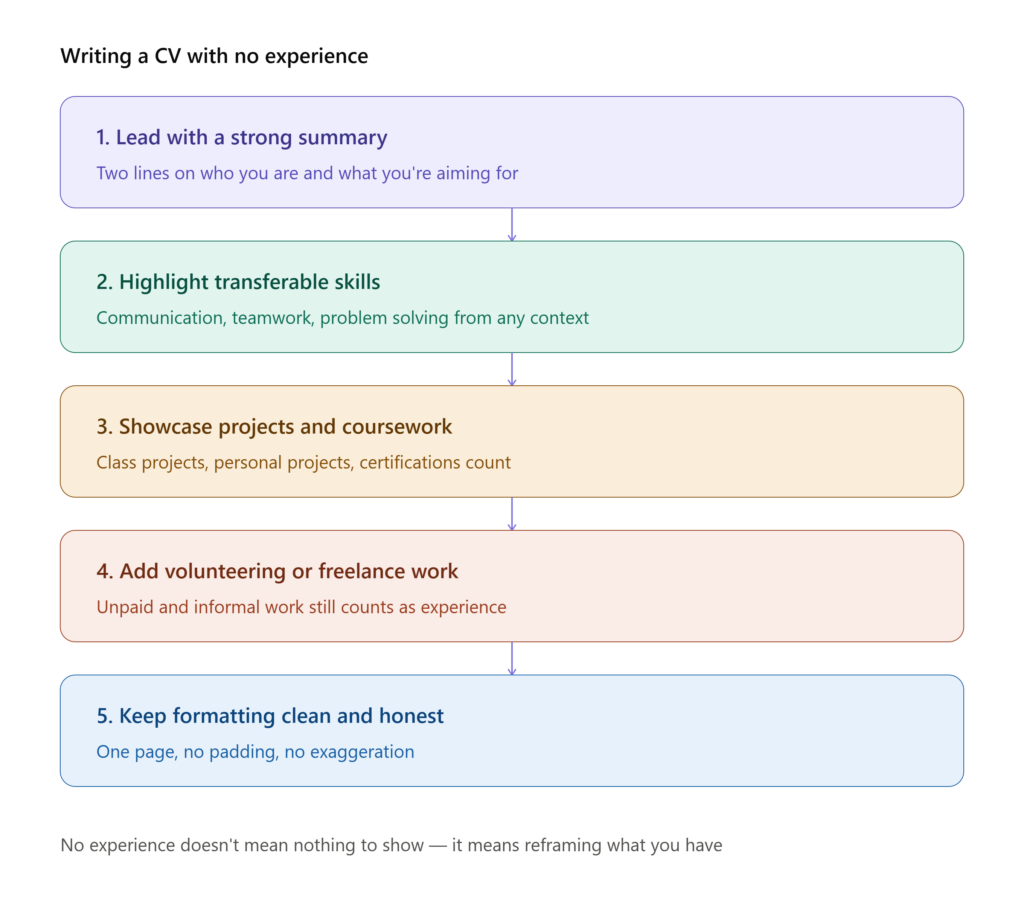
The truth is that having no formal work experience does not mean you have nothing to offer. Employers are not only looking for people who have held previous jobs. They are also looking for potential, willingness to learn, problem-solving abilities, and transferable skills.
A CV without work experience is not a blank page. It is an opportunity to showcase your abilities, achievements, and experiences gained through education, projects, volunteering, and everyday responsibilities. The key is knowing how to present these experiences in a way that employers understand and value.
Change Your Understanding of Experience
The first step is to redefine what “experience” means.
Many people believe experience only comes from paid employment. However, experience includes:
- School projects
- University assignments
- Volunteer work
- Sports teams
- Student leadership roles
- Personal projects
- Freelance work
- Community involvement
- Helping family businesses
- Organising events
Any activity where you learned skills, solved problems, or achieved results counts as experience.
Once you understand this, writing your CV becomes much easier.
Start with a Strong Professional Summary
Because you don’t have a long employment history, your professional summary becomes extremely important.
This short paragraph at the top of your CV should explain:
- Who you are
- What skills you have
- What type of opportunity you are seeking
Weak Example:
“Recent graduate looking for an entry-level job.”
This statement is too general and does not tell the employer anything useful.
Better Example:
“Information Technology graduate with hands-on experience in troubleshooting computers, supporting users, and building personal software projects. Seeking an entry-level IT support role where I can apply my technical skills and continue learning.”
This version is specific and immediately highlights your value.
Focus on Transferable Skills
Transferable skills are abilities you can use in different jobs and industries.
Examples include:
- Communication
- Problem-solving
- Teamwork
- Leadership
- Time management
- Organisation
- Customer service
- Computer literacy
However, simply listing these skills is not enough.
Instead of:
- Communication
- Teamwork
- Leadership
Write:
- Presented research findings to a class of 50 students and received a distinction.
- Worked in a team of five students to complete a six-month project before the deadline.
- Led a community clean-up initiative involving 30 volunteers.
Employers prefer evidence rather than empty claims.
Include Projects
Projects are one of the best ways to replace traditional work experience.
Examples of projects include:
IT Students
- Created a website.
- Built a mobile application.
- Developed a database system.
- Set up a computer network.
Marketing Students
- Managed social media pages.
- Designed promotional campaigns.
- Created content for an organisation.
Business Students
- Conducted market research.
- Prepared business plans.
- Organised events.
Write projects using action statements and measurable results.
Example:
Developed an inventory management system using C# and SQL Server that reduced data entry time by 40%.
Even if the project was completed for school, it still demonstrates practical experience.
Include Volunteer Work
Volunteer work is valuable because it shows initiative and responsibility.
Examples include:
- Tutoring students
- Assisting community organisations
- Managing social media pages
- Helping at local events
- Supporting non-profit organisations
Volunteer work should be written exactly like a normal job.
Example:
IT Support Volunteer
Community Centre | January 2025 – June 2025
- Assisted staff with computer troubleshooting.
- Installed software and configured printers.
- Maintained computer systems for over 20 users.
This shows practical skills even though the work was unpaid.
Mention Certifications and Online Learning
Employers appreciate candidates who take the initiative to learn independently.
Include:
- Online courses
- Professional certifications
- Workshops
- Training programmes
Examples:
- CompTIA A+
- Cisco CCNA
- Microsoft Azure Fundamentals
- Google IT Support Certificate
- Data Analytics Certifications
Continuous learning demonstrates motivation and commitment.
Showcase Achievements
Achievements help employers understand your potential.
Examples:
- Graduated with distinction.
- Won a programming competition.
- Received academic awards.
- Served as a student leader.
- Managed a successful project.
Achievements make your CV stand out from other entry-level applicants.
Keep the CV Clean and Professional
A beginner’s CV should ideally be one page.
Recommended sections:
- Contact Information
- Professional Summary
- Skills
- Education
- Projects
- Certifications
- Volunteer Experience
- Achievements
Avoid:
- Fancy graphics
- Unnecessary colours
- Long paragraphs
- False information
- Skills you do not possess
Simple and professional formatting is always more effective.
Use Numbers Whenever Possible
Numbers make your experiences feel real and measurable.
Examples:
- Managed social media page with 1,000 followers.
- Assisted 30 users with technical issues.
- Completed a project three weeks before the deadline.
- Coordinated an event attended by 200 people.
Employers trust measurable achievements.
Tailor Your CV for Every Application
Do not send the same CV to every employer.
Read the job description carefully and adjust your CV to highlight the most relevant skills and experiences.
For example:
If applying for an IT Support role, emphasize:
- Troubleshooting
- Computer repairs
- Customer service
- Networking knowledge
If applying for an administrative role, emphasize:
- Communication
- Organisation
- Microsoft Office
- Data capturing
Customising your CV increases your chances of being shortlisted.
Believe That You Have Something to Offer
The biggest challenge when writing a no-experience CV is often confidence.
Many people think they have nothing valuable to put on paper.
The reality is different.
You have likely:
- Solved problems.
- Worked with other people.
- Learned new skills.
- Managed responsibilities.
- Completed projects.
- Helped others.
These experiences matter.
Your goal is not to pretend that you have years of employment history. Your goal is to present your existing experiences in a way that employers can recognise and appreciate.
Final Thoughts
Everyone starts somewhere. Every experienced professional once had no experience at all.
A strong CV is not about having a long employment history. It is about showing your potential, demonstrating your skills, and proving that you are ready to learn and contribute.
When you focus on your projects, transferable skills, volunteer work, and achievements, you create a CV that tells employers:
“I may not have formal experience yet, but I have the ability, determination, and willingness to succeed.”
That mindset can turn a “no experience” CV into the opportunity that opens the door to your first job.