Hiring has changed more in the last three years than in the previous ten. Recruiters are scanning hundreds of applications with AI-assisted screening tools, hiring managers expect candidates to already be comfortable with AI-powered workflows, and “soft skills” that used to feel like filler now genuinely separate shortlisted candidates from the rest. If your CV still reads like it was written in 2019, it’s quietly working against you.
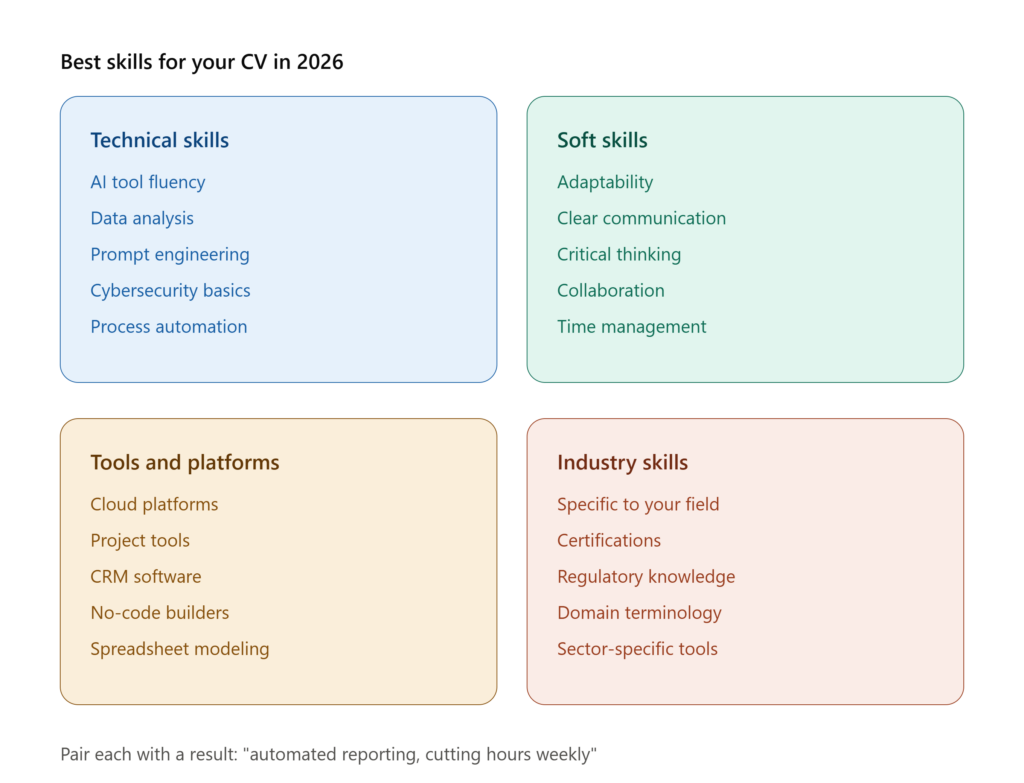
This guide breaks down the skills that actually matter in 2026, organized into four categories, with real examples of how to phrase them so they don’t sound like a generic list pulled off a template site.
Why your skills section needs an update
A skills section isn’t a word cloud — it’s a filtering mechanism. Recruiters and applicant tracking systems scan for specific keywords tied to the role, and hiring managers skim the top third of a CV in seconds. If the skills you list are vague (“hard worker,” “team player,” “proficient in Microsoft Office”), you blend into the pile. If they’re specific, current, and backed by an outcome, you stand out before anyone reads your work history.
The goal in 2026 isn’t to list everything you’ve ever touched. It’s to show a small set of skills that prove you can do the job today, with the tools the job actually uses today.
1. Technical skills
Technical skills are the most heavily screened category, especially by automated systems, so precision matters more than breadth.
AI tool fluency. This is the single biggest shift from a few years ago. Knowing how to work alongside AI tools — for drafting, research, coding assistance, or data analysis — has become as expected as basic spreadsheet skills once were. Don’t just write “AI tools.” Be specific: “Used AI-assisted coding tools to cut feature development time by 30%” or “Built custom prompt workflows to automate first-draft customer responses.”
Data analysis. Even outside data-specific roles, the ability to read a dashboard, spot a trend, and explain what it means is valuable. Example: “Analyzed campaign performance data to identify a 15% drop in conversion, leading to a redesigned checkout flow.”
Prompt engineering. No longer a niche skill. If you’ve designed prompts, built internal AI workflows, or fine-tuned how your team uses generative tools, say so directly rather than burying it under “AI experience.”
Cybersecurity basics. As remote work and cloud tools expand, baseline security awareness — phishing recognition, secure data handling, access management — is increasingly listed as a requirement even in non-technical roles.
Process automation. Tools like Zapier, Make, or built-in automation features in CRMs and project tools. Example: “Automated weekly reporting, cutting a 3-hour manual task down to 20 minutes.”
2. Soft skills
Soft skills get dismissed as fluff when they’re listed alone, but framed correctly, they’re often the deciding factor between two technically equal candidates.
Adaptability. Companies are restructuring teams and tools faster than ever. Show it with evidence: “Adapted to three platform migrations in 18 months without disruption to client deliverables.”
Clear communication. Especially valuable in hybrid and asynchronous teams. Example: “Wrote documentation that reduced onboarding time for new hires by half.”
Critical thinking. Increasingly important as AI handles more routine output — humans are valued for judgment, not just execution. Example: “Reviewed AI-generated reports for accuracy before client delivery, catching errors that would have affected three major decisions.”
Collaboration. Cross-functional work is the norm, not the exception. Example: “Partnered with design, engineering, and marketing to launch a product update on a six-week timeline.”
Time management. With more autonomy in remote and hybrid roles, the ability to self-manage workload is a real differentiator. Avoid the generic phrase — show it through a result, like meeting a specific deadline or juggling a defined number of concurrent projects.
3. Tools and platforms
This category changes the fastest, so keep it current rather than listing every tool you’ve touched over a decade.
Cloud platforms. AWS, Azure, or Google Cloud experience, even at a basic operational level, is relevant well beyond engineering roles now.
Project management tools. Asana, Notion, Linear, Monday — list the ones relevant to the role, and where possible, mention scale: “Managed a 40-task sprint board across three teams using Linear.”
CRM software. Salesforce, HubSpot, and similar platforms remain core to sales, marketing, and customer success roles. Specify what you did with it: “Built automated lead-scoring workflows in HubSpot that improved qualified lead volume by 20%.”
No-code builders. Tools like Webflow, Bubble, or Airtable signal that you can build and ship without waiting on engineering resources — a skill hiring managers increasingly value for speed.
Spreadsheet modeling. Still relevant, but the bar has moved past “knows Excel.” Show depth: pivot tables, financial modeling, or integrating spreadsheets with automation tools.
4. Industry-specific skills
Generic skills get you past the first filter; industry-specific ones get you the interview. This is the category that varies most by field, but the principle is the same everywhere: be precise about what you know, not just that you know it.
This includes things like specific certifications (project management, cloud, compliance), regulatory knowledge relevant to your sector, domain terminology that signals real experience rather than surface familiarity, and sector-specific software that’s central to how the role operates day to day.
If you’re in healthcare, that might be familiarity with specific compliance frameworks. If you’re in finance, it might be a particular modeling certification. If you’re in marketing, it might be expertise in a specific ad platform’s newest features. Research the actual job postings in your field and mirror the language they use — not to game a system, but because that language is genuinely how people in that industry talk about the work.
How to actually write these on your CV
Three rules make the difference between a forgettable skills section and one that gets you shortlisted:
- Pair every skill with a result. “Process automation” tells a recruiter nothing on its own. “Automated weekly reporting, cutting a 3-hour task to 20 minutes” tells them exactly what you’re capable of.
- Mirror the job posting’s language, but only where it’s true. If the posting says “stakeholder management” and that’s what you did, use that exact phrase — it helps both human readers and automated screening tools recognize the match.
- Cut anything outdated. If a tool or skill hasn’t been part of your actual work in the last two to three years, it’s taking up space that a current, relevant skill could use instead.
The bottom line
The CVs that get noticed in 2026 aren’t the ones with the longest skills list — they’re the ones that prove, in a handful of specific lines, that the candidate can do the job with the tools the job actually requires. Pick a focused set across technical skills, soft skills, tools, and industry knowledge, back each one with a concrete outcome, and let that precision do the work that a generic list never could.