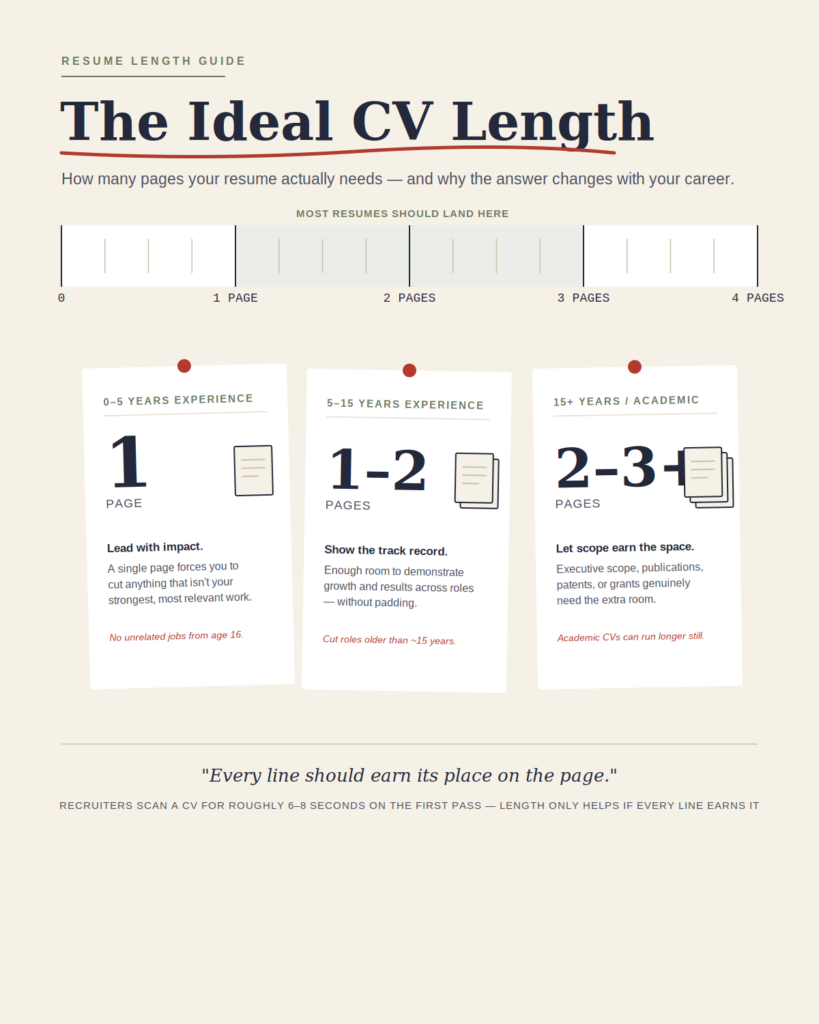
One of the most common questions job seekers ask is, “How long should my CV be?” Some people believe a longer CV demonstrates more experience, while others think keeping it to a single page is always the best option.
The truth is that there is no universal rule. The ideal CV length depends on your level of experience, the type of job you’re applying for, and the information that is most relevant to the employer.
Recruiters don’t judge your CV by the number of pages. Instead, they focus on whether it is clear, well-organized, and highlights the qualifications and experience that match the role.
In this guide, you’ll learn how long your CV should be, when to use one page or two, what to include, and how to keep your CV concise without leaving out important information.
Does CV Length Really Matter?
Yes—but not in the way many people think.
Recruiters often review dozens or even hundreds of applications for a single vacancy. They don’t have time to read every word of every CV. Instead, they quickly scan for key information such as:
- Relevant work experience
- Skills
- Qualifications
- Achievements
- Career progression
A CV that is too short may leave out important details, while one that is too long may make it difficult for recruiters to find the information they need.
The goal is not to create the shortest CV possible. The goal is to create a CV that includes everything important—and nothing unnecessary.
The Ideal CV Length by Experience Level
Students and First-Time Job Seekers
Recommended length: One page
If you’re still in school, recently graduated, or applying for your first job, a one-page CV is usually enough.
Focus on:
- Education
- Skills
- Volunteer work
- Internships
- School projects
- Certifications
- Extracurricular activities
Since you have limited work experience, there’s no need to add unnecessary content just to fill extra pages.
Early-Career Professionals
Recommended length: One to two pages
If you have between one and five years of work experience, your CV will likely fit comfortably on one or two pages.
Include:
- Professional summary
- Relevant work experience
- Key achievements
- Skills
- Education
- Professional certifications
Only include experience that supports your application.
Experienced Professionals
Recommended length: Two pages
For professionals with several years of experience, a two-page CV is widely accepted and often preferred.
This gives you enough space to highlight:
- Career progression
- Leadership responsibilities
- Major projects
- Professional achievements
- Industry certifications
- Technical skills
Two pages are usually sufficient for most industries.
Senior Managers and Executives
Recommended length: Two to three pages
Senior professionals often need additional space to explain:
- Executive leadership
- Strategic initiatives
- Business growth
- Team management
- Industry expertise
- Board memberships
- Publications or speaking engagements
However, every section should provide value.
Is a One-Page CV Better?
Not always.
A one-page CV works well if:
- You are a student.
- You’re applying for your first job.
- You have limited experience.
- You’re applying for internships or learnerships.
Trying to squeeze ten years of experience onto one page may force you to remove valuable achievements.
Quality matters more than page count.
When Is a Two-Page CV Acceptable?
A two-page CV is perfectly acceptable when you have enough relevant information to justify it.
Examples include:
- Several years of work experience
- Multiple qualifications
- Professional certifications
- Leadership roles
- Industry achievements
- Technical expertise
Many recruiters actually expect experienced professionals to submit two-page CVs.
Can a CV Be Three Pages?
Yes—but only when necessary.
Three-page CVs are generally appropriate for:
- Senior executives
- Academic positions
- Researchers
- Medical professionals
- Engineers with extensive project portfolios
- Consultants with significant industry experience
If your third page contains outdated or irrelevant information, it’s better to remove it.
What Recruiters Want to See First
Recruiters often spend only a few seconds scanning a CV before deciding whether to continue reading.
The top half of the first page should clearly include:
- Your name
- Contact information
- Professional summary
- Key skills
- Most recent work experience
Make sure the most important information appears early in your CV.
What Should You Leave Out?
Many CVs become unnecessarily long because they include information employers don’t need.
Consider removing:
- Primary school education
- Outdated certifications
- Irrelevant work experience
- Personal references (unless requested)
- Long paragraphs
- Personal hobbies that don’t relate to the job
- Marital status, religion, or political views
Every section should help strengthen your application.
How to Keep Your CV Concise
Here are some practical ways to reduce unnecessary length:
Use Bullet Points
Bullet points make your CV easier to scan than long paragraphs.
Instead of writing a large block of text, list your responsibilities and achievements clearly.
Focus on Achievements
Rather than listing every task you performed, highlight your accomplishments.
For example:
Instead of:
- Responsible for customer service.
Write:
- Assisted more than 50 customers daily while maintaining a 95% customer satisfaction rating.
Achievements provide stronger evidence of your abilities.
Remove Repetition
Avoid repeating the same skills or responsibilities across multiple jobs unless they’re directly relevant.
Keep descriptions unique and focused.
Prioritize Recent Experience
Employers are usually more interested in your recent work history than jobs you held many years ago.
Summarize older positions if they are less relevant to the role you’re applying for.
Common CV Length Mistakes
Avoid these common mistakes:
Including Every Job You’ve Ever Had
Not every position needs detailed descriptions, especially if it’s unrelated to your current career goals.
Using Large Paragraphs
Dense paragraphs make your CV difficult to read.
Use short bullet points instead.
Listing Every Skill
Choose skills that match the job you’re applying for instead of creating a long, generic list.
Adding Unnecessary Personal Information
Employers don’t need information that isn’t relevant to your ability to perform the job.
Making the Font Too Small
Some candidates reduce the font size to fit everything onto one page.
If recruiters struggle to read your CV, they may move on to the next applicant.
Use a professional font size between 10 and 12 points for the main text.
Does an ATS Care About CV Length?
An Applicant Tracking System (ATS) does not reject a CV simply because it is one, two, or three pages long.
Instead, ATS software focuses on:
- Keywords
- Skills
- Work experience
- Qualifications
- Formatting
As long as your CV is clearly structured and contains relevant information, page length is not a deciding factor.
Quick CV Length Checklist
Before submitting your CV, ask yourself:
- Is every section relevant to the job?
- Have I removed outdated information?
- Does my CV highlight achievements instead of just responsibilities?
- Is the formatting clean and easy to read?
- Can a recruiter quickly identify my skills and experience?
- Have I avoided unnecessary repetition?
If the answer is yes, your CV is likely the right length.
Frequently Asked Questions
Can a CV be only one page?
Yes. One-page CVs are ideal for students, graduates, and entry-level job seekers with limited experience.
Is a two-page CV too long?
No. Two pages are considered the standard for most professionals with several years of experience.
Should I remove older jobs?
If older positions are unrelated to the role you’re applying for, you can summarize them or leave them out to keep your CV focused.
What if I have a lot of experience?
Focus on your most relevant roles and achievements. If your experience genuinely requires three pages, that’s acceptable—as long as every section adds value.
Final Thoughts
There is no perfect CV length that guarantees you’ll get hired. What matters most is that your CV clearly demonstrates why you’re the right candidate for the job.
For most people, one to two pages is ideal. Students and first-time job seekers should aim for a concise one-page CV, while experienced professionals can confidently use two pages to showcase their achievements. Only use a third page when your experience genuinely requires it.
Remember, recruiters are not counting pages—they’re looking for relevant skills, measurable accomplishments, and a clear career story. By keeping your CV focused, organized, and tailored to each job application, you’ll improve your chances of standing out and securing more interviews.