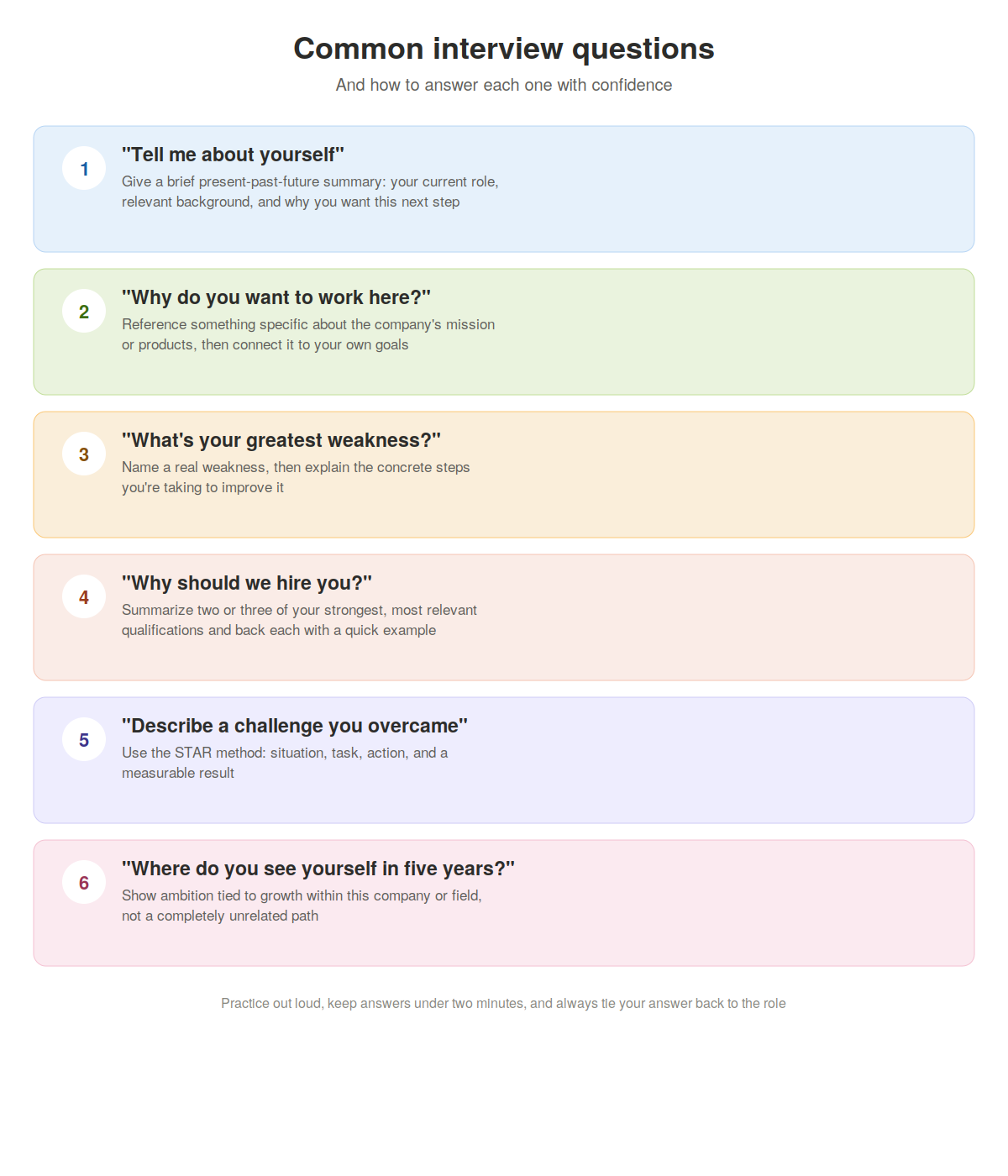
Walking into an interview without preparing your answers is one of the biggest mistakes job seekers make. While you can’t predict every question, most employers ask similar questions to understand your skills, personality, and whether you’re the right fit for the role.
The key isn’t memorising answers word for word. Instead, understand what the interviewer wants to know and prepare examples that demonstrate your experience, skills, and achievements.
Here’s how to answer the most common interview questions with confidence.
1. Tell Me About Yourself
This is usually the first question in an interview. The interviewer wants a brief overview of your professional background, not your entire life story.
A good answer should include:
- Your current situation
- Relevant experience or education
- Your key strengths
- Why you’re interested in the position
Example:
“I recently graduated with a Diploma in Information Technology, where I specialised in networking and software development. During my studies, I completed several practical projects involving network configuration and database development. I’m passionate about technology and problem-solving, and I’m excited about this opportunity because it allows me to apply my technical skills while continuing to learn and grow professionally.”
Keep your answer between one and two minutes.
2. Why Do You Want to Work Here?
The interviewer wants to know whether you’ve researched the company and whether you’re genuinely interested in the role.
Before your interview, research:
- The company’s products or services
- Their mission and values
- Recent achievements
- Company culture
Example:
“I’ve researched your company and I’m impressed by your commitment to innovation and employee development. I enjoy working in environments where continuous learning is encouraged, and I believe my skills and career goals align well with your organisation.”
Avoid saying:
- “I need a job.”
- “The salary looks good.”
- “It’s close to home.”
3. Why Should We Hire You?
This is your opportunity to explain what makes you different from other candidates.
Focus on:
- Relevant skills
- Experience
- Work ethic
- Ability to solve problems
Example:
“I believe I can make a positive contribution because I learn quickly, adapt easily to new environments, and always take responsibility for my work. I enjoy solving problems, working with teams, and continuously improving my skills. I’m confident I can add value while continuing to grow within the company.”
4. What Are Your Greatest Strengths?
Choose strengths that match the job.
Examples include:
- Communication
- Problem-solving
- Teamwork
- Leadership
- Time management
- Adaptability
- Attention to detail
- Technical skills
Example:
“One of my biggest strengths is problem-solving. I enjoy analysing challenges and finding practical solutions. During a college project, I helped redesign our network setup after identifying performance issues, which improved our project’s overall results.”
Always support your strength with a real example.
5. What Is Your Biggest Weakness?
Employers don’t expect perfection. They want honesty and self-awareness.
Choose a genuine weakness that you’re actively improving.
Example:
“Earlier in my studies I wasn’t comfortable speaking in front of groups. To improve, I volunteered to present during class projects. Over time my confidence has grown, and I’m now much more comfortable delivering presentations.”
Never say:
- “I don’t have any weaknesses.”
- “I work too hard.”
These answers sound unrealistic.
6. Tell Me About a Time You Faced a Challenge
Use the STAR Method.
- Situation
- Task
- Action
- Result
Example:
“During a group assignment, one team member stopped contributing just before the deadline. I reorganised the remaining tasks, communicated regularly with the rest of the team, and ensured everyone knew their responsibilities. We completed the project on time and received one of the highest marks in the class.”
Employers want to see how you solve problems under pressure.
7. Tell Me About a Time You Made a Mistake
Everyone makes mistakes.
The interviewer wants to know:
- Do you take responsibility?
- Did you learn from it?
Example:
“While working on a project, I submitted a report without checking one of the calculations. My lecturer pointed out the mistake. Since then, I’ve developed a habit of reviewing my work carefully before submitting it. That experience taught me the importance of quality checks.”
Focus on what you learned.
8. Where Do You See Yourself in Five Years?
Employers want people who plan to grow with the company.
Example:
“In five years, I’d like to have developed strong expertise in my field, taken on more responsibility, and contributed to larger projects. I’m committed to continuous learning and hope to grow into a leadership role as I gain experience.”
Avoid saying:
- “I want your job.”
- “I don’t know.”
9. How Do You Handle Pressure?
Most workplaces involve deadlines and unexpected challenges.
Example:
“I stay organised by prioritising tasks, creating realistic schedules, and focusing on one problem at a time. When pressure increases, I communicate with my team, remain calm, and concentrate on delivering quality work rather than rushing.”
Give an example if possible.
10. Why Did You Leave Your Previous Job?
Stay professional.
Never criticise your previous employer.
Example:
“I appreciated everything I learned in my previous role, but I reached a point where there were limited opportunities for growth. I’m now looking for a position where I can continue developing my skills and contribute to a larger organisation.”
11. What Salary Are You Expecting?
Research the market before the interview.
Example:
“Based on my research and the responsibilities of this role, I’m looking for a salary that’s competitive within the industry. However, I’m flexible and would be happy to discuss the complete compensation package.”
If you’re unsure, avoid giving a very specific number too early.
12. Do You Have Any Questions for Us?
Always ask questions.
Good examples include:
- What does success look like in this role?
- What training opportunities do you offer?
- Can you tell me more about the team I’ll be working with?
- What are the biggest challenges someone in this position will face?
- What are the next steps in the recruitment process?
Questions demonstrate genuine interest.
Interview Tips That Make a Difference
- Research the company before your interview.
- Read the job description several times.
- Practice answering questions aloud.
- Use the STAR method for behavioural questions.
- Dress professionally.
- Arrive at least 15 minutes early.
- Maintain eye contact and smile naturally.
- Listen carefully before answering.
- Keep your answers clear and concise.
- Bring copies of your CV and supporting documents.
- Turn off your phone before the interview.
- Send a thank-you email within 24 hours.
Final Thoughts
A successful interview isn’t about having the perfect answer to every question. It’s about showing that you understand the role, can communicate confidently, and have the skills and attitude to succeed. Preparation gives you confidence, and confidence helps you present your best self.
Practice your answers, research the company, prepare examples from your own experience, and remember that interviews are conversations—not interrogations. The more prepared you are, the better your chances of leaving a lasting positive impression and receiving the job offer.