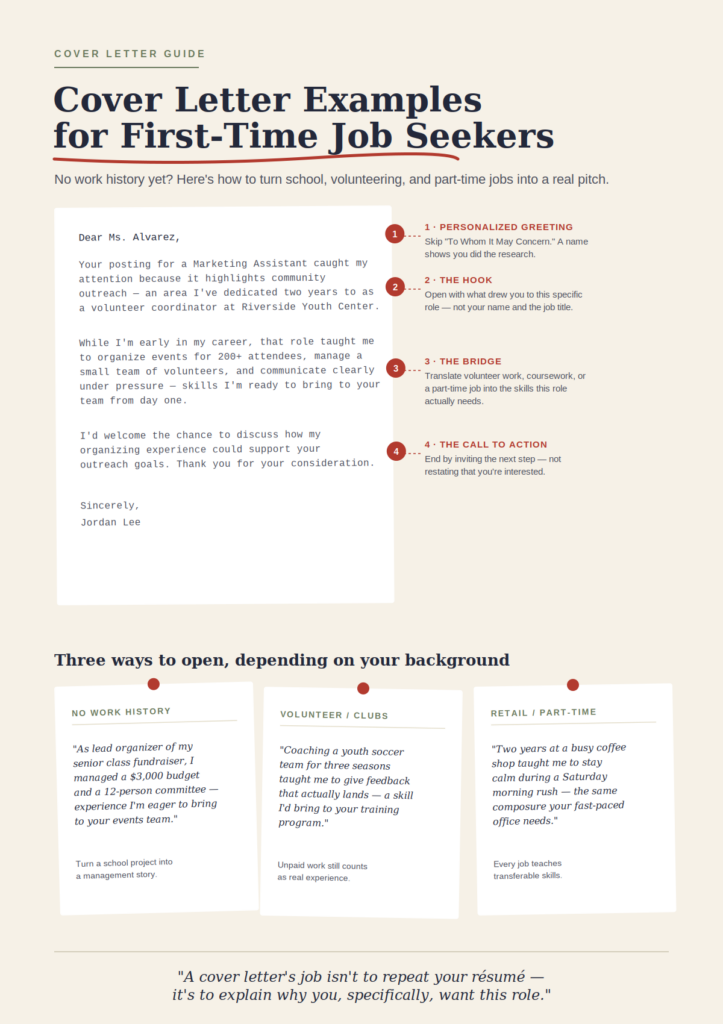
Applying for your first job can be both exciting and intimidating. One of the biggest challenges many first-time job seekers face is writing a cover letter when they have little or no work experience.
The good news is that employers understand everyone has to start somewhere. They are not always looking for years of experience—they’re looking for candidates who are eager to learn, have the right attitude, and show potential.
A well-written cover letter can help you make a strong first impression and explain why you’re a great fit for the role, even if your CV is short.
This guide will show you what a cover letter is, why it matters, how to write one, and provide sample cover letters you can customize for your own job applications.
What Is a Cover Letter?
A cover letter is a one-page document that accompanies your CV when applying for a job.
Its purpose is to introduce yourself, explain why you’re interested in the position, and highlight the skills and qualities that make you a suitable candidate.
Unlike your CV, which lists your qualifications and experience, a cover letter allows you to tell your story and show your enthusiasm for the role.
Think of it as your opportunity to speak directly to the employer before meeting them in person.
Do You Need a Cover Letter?
Not every employer requires a cover letter, but submitting one can give you an advantage over other candidates.
A strong cover letter shows that you:
- Have taken the time to personalize your application.
- Are genuinely interested in the company.
- Can communicate professionally.
- Understand the role you’re applying for.
When several applicants have similar qualifications, a thoughtful cover letter can help you stand out.
Can You Write a Good Cover Letter Without Experience?
Absolutely.
If you don’t have previous work experience, focus on what you do have, such as:
- Your education
- School or university projects
- Volunteer work
- Leadership roles
- Extracurricular activities
- Transferable skills
- A willingness to learn
Employers hiring entry-level candidates know that experience has to start somewhere.
What Should a Cover Letter Include?
A professional cover letter usually contains the following sections:
- Your contact information
- The date
- The employer’s name and company (if known)
- A professional greeting
- An introduction
- The main body
- A closing paragraph
- A professional sign-off
Keep your cover letter to one page.
How to Write a Strong Introduction
Your opening paragraph should immediately explain:
- The position you’re applying for.
- Where you found the vacancy.
- Why you’re interested.
Example:
I am writing to express my interest in the Customer Service Assistant position advertised on your website. As a motivated and enthusiastic recent graduate, I am excited about the opportunity to begin my career with your company and contribute to your team.
This introduction is clear, professional, and gets straight to the point.
Highlight Your Strengths Instead of Experience
If you don’t have formal work experience, focus on skills you’ve developed through other activities.
Examples include:
- Teamwork from group assignments
- Communication through presentations
- Leadership from student organizations
- Problem-solving from academic projects
- Time management from balancing studies and responsibilities
Show employers how these experiences have prepared you for the workplace.
Explain Why You Want the Job
Employers appreciate candidates who have taken time to learn about the company.
Mention:
- Why you admire the company
- How the role fits your career goals
- What excites you about the opportunity
Avoid generic statements like:
“I need a job.”
Instead, explain how the role aligns with your ambitions and how you hope to contribute.
Sample Cover Letter for a First-Time Job Seeker
Your Name
Your Address
Your Phone Number
Your Email Address
Date
Hiring Manager
ABC Company
Dear Hiring Manager,
I am writing to apply for the Administrative Assistant position advertised on your careers page. Although I am beginning my professional career, I am eager to contribute my strong organizational skills, positive attitude, and willingness to learn.
During my studies, I developed excellent communication, teamwork, and time management skills through group projects and presentations. I am comfortable using Microsoft Office applications and enjoy solving problems in a structured and organized way.
I am particularly interested in joining ABC Company because of its reputation for supporting employee growth and providing excellent customer service. I believe this role would allow me to develop valuable workplace experience while making a positive contribution to your team.
I would appreciate the opportunity to discuss how my skills and enthusiasm can benefit your organization. Thank you for considering my application. I look forward to hearing from you.
Yours sincerely,
Your Name
Sample Cover Letter for a Graduate
Dear Hiring Manager,
I recently completed my qualification in Business Management and am excited to apply for the Graduate Trainee position at your organization.
Throughout my studies, I gained practical knowledge in business operations, communication, and project management. I also worked on several team-based projects that strengthened my leadership and problem-solving abilities.
I am eager to begin my professional career with an organization that values innovation, learning, and teamwork. I am confident that my strong work ethic and commitment to continuous improvement will enable me to make a valuable contribution.
Thank you for considering my application. I welcome the opportunity to discuss my qualifications further.
Yours sincerely,
Your Name
Sample Cover Letter for a Retail Job
Dear Hiring Manager,
I am excited to apply for the Retail Sales Assistant position at your store.
Although I do not have formal retail experience, I have developed excellent communication and customer service skills through volunteering and community activities. I enjoy working with people, learning new skills, and helping customers have positive experiences.
I am a reliable, hardworking individual who enjoys working in team environments. I am confident that my enthusiasm and willingness to learn would allow me to become a valuable member of your team.
Thank you for your time and consideration. I hope to have the opportunity to discuss my application with you.
Yours sincerely,
Your Name
Cover Letter Tips for Beginners
To improve your chances of success:
Tailor Every Cover Letter
Avoid sending the same cover letter to every employer.
Personalize it by mentioning:
- The company name
- The job title
- Why you want to work there
- Relevant skills
Keep It Short
A cover letter should usually be between 250 and 400 words.
Recruiters appreciate concise, focused writing.
Use Professional Language
Avoid slang, emojis, or overly casual language.
Write in a professional but friendly tone.
Show Enthusiasm
Employers appreciate candidates who genuinely want the opportunity.
Let your motivation come through naturally.
Proofread Carefully
Check for:
- Spelling mistakes
- Grammar errors
- Incorrect company names
- Formatting issues
Even small mistakes can create a poor first impression.
Common Cover Letter Mistakes
Avoid these common errors:
- Repeating everything from your CV.
- Making the letter too long.
- Using generic greetings when you know the hiring manager’s name.
- Talking only about what you want instead of how you can help the employer.
- Sending the same cover letter to multiple companies without editing it.
- Forgetting to proofread.
A strong cover letter complements your CV—it doesn’t duplicate it.
Frequently Asked Questions
Can I get hired without a cover letter?
Yes. Some employers don’t require one. However, including a professional cover letter can strengthen your application and help you stand out.
How long should my cover letter be?
Aim for one page, or approximately 250–400 words.
Should I mention that I have no experience?
You don’t need to focus on what you lack. Instead, highlight your skills, education, and willingness to learn.
Can I use the same cover letter for every job?
No. Always tailor your cover letter to the specific company and position.
Final Thoughts
Writing your first cover letter may seem challenging, but it is also an opportunity to introduce yourself beyond your CV. Even without formal work experience, you can demonstrate your enthusiasm, transferable skills, and readiness to learn.
Remember that employers hiring entry-level candidates understand that everyone starts somewhere. They are often looking for potential just as much as experience. A well-structured, personalized cover letter can show that you are motivated, professional, and prepared to contribute.
Take the time to tailor each cover letter, proofread it carefully, and focus on what you can offer rather than what you lack. With practice, you’ll become more confident, and each application will become stronger than the last.